Textual Chef Textual Chef

Tteokkochi

Korean street food skewers with chewy rice cakes and vegetables coated in a sweet and spicy gochujang glaze.

27 minEasyServes 4180 cal/serving

KoreanAppetizerStovetopVegetarian

Cook this free in the appFree. No download, no account. The screen stays awake and each step can run its own timer.

Ingredients

  • 2 cups Korean rice cakes (tteok), cut into 1-inch pieces
  • 1/2 onion, cut into 1-inch pieces
  • 1/2 green bell pepper, cut into 1-inch pieces
  • 2 tbsp gochujang (Korean red chili paste)
  • 2 tbsp honey
  • 1 tbsp soy sauce
  • 1 tsp sesame oil
  • 2 garlic cloves, minced
  • 2 tbsp vegetable oil
  • 2 tsp sesame seeds

Instructions

  1. 1

    Soak wooden skewers in water for 20 minutes.

  2. 2

    Thread the 2 cups cut into 1-inch pieces Korean rice cakes (tteok), 1/2 cut into 1-inch pieces onion, and 1/2 cut into 1-inch pieces green bell pepper alternately onto the skewers.

  3. 3

    In a small bowl, mix 2 tbsp gochujang (Korean red chili paste), 2 tbsp honey, 1 tbsp soy sauce, 1 tsp sesame oil, and 2 minced garlic cloves.

  4. 4

    Heat 2 tbsp vegetable oil in a large pan or griddle over medium-high heat.

  5. 5

    Place the skewers on the hot pan and cook for 2 minutes on each side until the Korean rice cakes (tteok) are slightly golden.

  6. 6

    Brush the skewers generously with the gochujang (Korean red chili paste) mixture on both sides.

  7. 7

    Continue cooking for another 2 minutes per side, brushing with more sauce as needed.

  8. 8

    Transfer to a serving plate and sprinkle with 2 tsp sesame seeds. Serve hot.

Cook this free in the appCooking it now? The app keeps the screen awake and times each step. Free, nothing to install.
Keep this recipe

Prints the ingredients and method only.

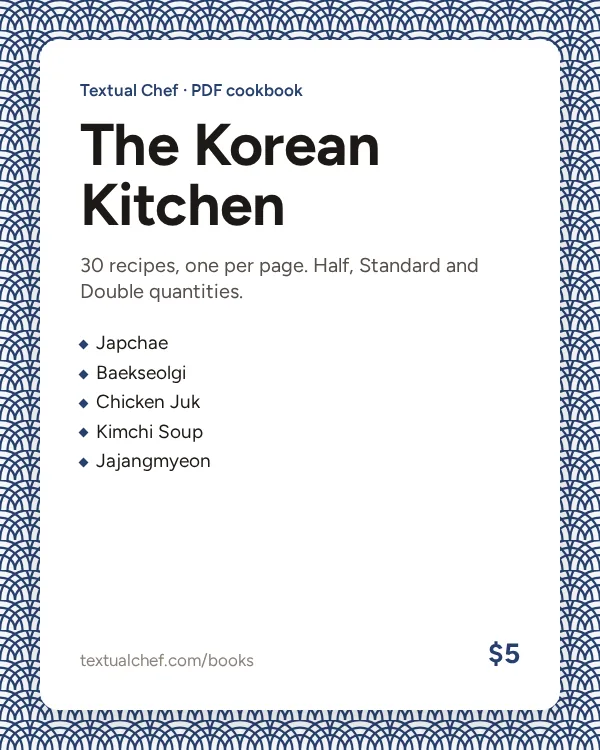
The Korean Kitchen 30 recipes from this kitchen in one printable PDF. $5, no account.

Questions

Why soak the skewers for Tteokkochi?

Step 1 reads: "Soak wooden skewers in water for 20 minutes." Dry wood burns. The soak in step 1 keeps the skewers from catching over the heat; metal skewers need none.

Do I need any special equipment for Tteokkochi?

Beyond a knife and a board, the method uses skewers (step 1) and a grill pan (step 4).

Is there a substitute for gochujang in Tteokkochi?

The entry for Tteokkochi calls for 2 tbsp gochujang (Korean red chili paste). In its place: Mix two parts sriracha or another chili paste with one part white miso and a pinch of sugar. It lands close on heat and body and a little short on fermented depth.

Is Tteokkochi spicy?

Moderately. The heat in Tteokkochi comes from 2 tbsp gochujang (Korean red chili paste). For a milder plate, start with half the gochujang and add more to taste at the end; nothing else in the method changes. For more, add it at the table rather than in the pot, so everyone sets their own level.

Can I make Tteokkochi gluten-free?

Yes. The gluten in Tteokkochi is 1 tbsp soy sauce. Swap the soy-based sauce for tamari or coconut aminos. Everything else proceeds as written.

Does Tteokkochi contain sesame?

Yes: 1 tsp sesame oil and 2 tsp sesame seeds. The full allergen list for this entry is gluten, soy and sesame. Seeds used as a garnish can simply be left off; the oil has no true substitute. Packaged ingredients vary by brand, so check labels if the allergy is serious.

How many calories are in Tteokkochi?

One serving (the recipe makes 4) is about 180 calories, with 3 g protein, 32 g carbohydrate and 4 g fat, plus 1 g fiber and 420 mg sodium.

Serve it with

Cook this free in the app

Textual Chef is 4,544 plain-text recipes, free to read and free to cook from. No account, no paywall, no ads, no life stories. Open this one in the app and each quantity sits inside the step that uses it, so you read once and cook.

Every recipe is curated or public-domain sourced, written to one template and checked before it publishes. Nothing here is a scraped blog post.

Cook this free in the appNo download needed. It opens in your browser. The kitchen tools (planner, shopping list, pantry, import) are $5.33 a month billed annually; the first 30 days are free.